
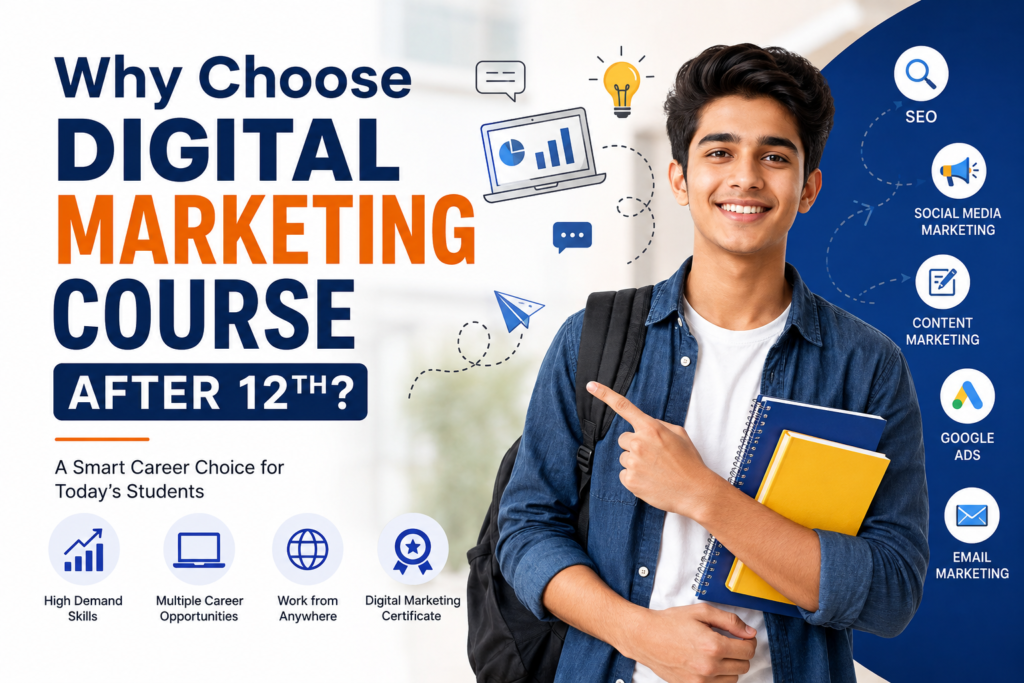
Finishing 12th is an exciting milestone, but it can also bring a lot of confusion. you Must choose a degree? Should you learn a professional skill? Should you start working? Or should you combine college with a skill-based course?
There is no single answer that works for every student.
However, the way businesses work has changed significantly. Companies, startups, creators, shops, professionals, and even local businesses use the internet to find customers and build their brands. This has created a growing need for people who understand online marketing.
This is where a digital marketing course after 12th can be worth considering.
Digital marketing combines several areas, including search engines, social media, websites, content, advertising, email, analytics, and creativity. It can give students an opportunity to develop practical skills while continuing their education.
The important point is that students should not choose digital marketing simply because someone says it is a “high-paying career.” A good career takes time to build.
Instead, think about digital marketing as a skill that you can develop through learning, practice, projects, internships, and real-world experience.
So, is digital marketing a good course after 12th? For students who enjoy technology, creativity, communication, business, or working with online platforms, it can certainly be an interesting option.
Let’s understand it properly.
What Is Digital Marketing?
Digital marketing means promoting a business, product, service, or personal brand through digital channels.
These channels can include:
- Search engines
- Websites
- Social media
- Online advertising
- Content platforms
- Video platforms
- Mobile applications
For example, imagine a clothing business that wants more customers.
It could create an Instagram page, publish product photos and videos, build a website, appear in Google Search, run paid advertisements, collect customer emails, and use analytics to understand which campaigns are working.
All of these activities can come under digital marketing.
Another example is a restaurant.
Someone searches Google for “restaurants near me.” The restaurant’s website, Google Business Profile, reviews, photos, content, and advertising can all influence whether that person chooses the restaurant.
Digital marketing is therefore not just about posting on Instagram.
It includes different skills that work together to attract people, build trust, generate leads, and support business growth.
Traditional Marketing vs Digital Marketing
Traditional marketing includes channels such as:
- Newspapers
- Television
- Radio
- Billboards
- Magazines
- Brochures
Digital marketing focuses on internet-based channels.
One major difference is that digital platforms can provide detailed information about audience behaviour and campaign performance.
For example, a business can analyse website visits, advertisement clicks, social media engagement, leads, and conversions.
This makes digital marketing a field where creativity and data often work together.
Why Consider a Digital Marketing Course After 12th?
There are several reasons students may want to explore digital marketing after completing school.
1. Learn a Practical Skill
A degree can provide valuable academic knowledge, but students can also benefit from developing practical skills.
Digital marketing is largely based on doing.
learn about the meaning of SEO . then actually research keywords, optimise a webpage, analyse search res ults, and create content.
You don’t just learn what social media marketing means. You can create a content calendar, design posts, analyse engagement, and experiment with different content formats.
This practical approach can help students understand how marketing works outside a classroom.
That doesn’t mean a practical course should replace formal education for everyone. Instead, students can consider adding digital marketing skills alongside their education.
2. The Digital Economy Creates Different Opportunities
Think about the businesses around you.
A local clothing store may have an Instagram account.
A restaurant may depend on Google Search and online reviews.
A startup may use Google Ads to generate leads.
An e-commerce company may use SEO, social media, email marketing, and performance advertising.
A creator may depend on YouTube, Instagram, search traffic, and brand partnerships.
All these activities require some understanding of digital platforms.
This creates different types of work within the broader marketing industry.
3. There Are Multiple Career Options
Digital marketing isn’t one job.
A student interested in writing may enjoy content marketing.
Someone who likes numbers and analysis may prefer performance marketing or analytics.
A creative student may enjoy social media and content creation.
Someone interested in websites may prefer SEO or website optimisation.
Possible career paths include:
- SEO Executive
- Social Media Executive
- Digital Marketing Executive
- Content Marketing Executive
- PPC Executive
- Performance Marketing Executive
- Email Marketing Executive
- Digital Marketing Analyst
- Content Creator
- Digital Marketing Freelancer
This variety allows students to explore different areas before deciding where they want to specialise.
4. Students From Different Streams Can Explore It
Digital marketing isn’t limited to one academic stream.
Students from:
- Science
- Commerce
- Arts
- Humanities
can explore the field.
A commerce student may enjoy the business and advertising side.
An arts student may enjoy communication and content.
A science student may enjoy analytics and technology.
Of course, your academic background can influence the areas you naturally enjoy, but it doesn’t automatically decide whether you can learn digital marketing.
Curiosity and willingness to practise matter more than simply coming from a particular stream.
5. You Can Start Building Experience Early
One advantage of learning a practical skill while you are young is that you can begin building experience early.
A student doesn’t necessarily need to wait until graduation to create a portfolio.
You can:
- Start a blog
- Create a website
- Manage a small social media page
- Practise SEO
- Create sample advertisements
- Analyse websites
- Volunteer for a small business
- Apply for internships
- Work on personal projects
These experiences can help you understand whether digital marketing actually interests you.
6. It Combines Creativity and Technology
Digital marketing sits somewhere between creative work and analytical work.
For example, creating an Instagram campaign requires creativity.
But understanding whether that campaign worked requires data.
Writing a blog requires communication.
Optimising it for search requires research and SEO knowledge.
Creating an advertisement requires a good message.
Improving the campaign requires analysing its performance.
This combination can make digital marketing interesting for students who don’t want a career that is purely technical or purely creative.
7. Freelancing Can Be an Option
Digital marketing skills can also be used for freelance work.
A freelancer works independently with clients rather than being a permanent employee of one company.
Students who develop useful skills may eventually offer services such as:
- Social media management
- SEO
- Content writing
- Canva design
- Website setup
- Email marketing
- Advertising support
However, freelancing should not be treated as instant income.
Before approaching clients, students should understand the service they are offering and ideally have examples of their work.
A strong portfolio is often more useful than simply telling someone, “I completed a course.”
8. It Can Help Future Entrepreneurs
Suppose you want to start a business someday.
You may need to understand how customers find businesses online.
You may need to create a website, manage social media, write content, run advertising campaigns, or understand customer behaviour.
Learning digital marketing can help you understand these areas.
Even if you eventually hire professionals to handle marketing, understanding the basics can help you make better business decisions.
Is Digital Marketing a Good Course After 12th?
The honest answer is: yes can be a good option for the right student.
Digital marketing isn’t automatically the best career for everyone.
You may enjoy it if you like:
- Social media
- Writing
- Creativity
- Technology
- Business
- Research
- Data
- Advertising
- Communication
- Learning new tools
You should also be comfortable with continuous learning.
Digital platforms change regularly. Search engines update their systems. Advertising platforms introduce new features. Social networks change their formats and algorithms.
So, if you want to enter this field, learning cannot stop when your course ends.
Digital marketing may be suitable for you if:
- You enjoy learning how online platforms work.
- You like experimenting with content.
- You are curious about why people buy things.
- You enjoy writing or communication.
- You don’t mind working with numbers and data.
- You are interested in business.
- You enjoy solving problems.
- You are willing to practise.
- You want to build practical skills.
- You are comfortable learning new tools.
On the other hand, if you strongly dislike computers, online platforms, communication, research, or continuous learning, you may want to explore other career options too.
Don’t choose a career only because it is trending.
Choose something that matches your interests, abilities, and long-term goals.
What Do You Learn in a Digital Marketing Course?
A good digital marketing course can cover several areas.
The exact curriculum differs between institutes, but students commonly encounter the following topics.
Search Engine Optimization (SEO)
SEO stands for Search Engine Optimization.
It is the process of improving webpages and online content so that they can perform better in search engine results.
Students may learn:
- Keyword research
- On-page SEO
- Technical SEO
- Off-page SEO
- Content optimisation
- Internal linking
- Search intent
- Website analysis
For example, if you create a blog about “best courses after 12th,” SEO can help you understand what students are searching for and how to make the article more useful and search-friendly.
SEO is a long-term skill. It requires research, testing, analysis, and patience.
Search Engine Marketing and Google Ads
Search engine marketing involves paid advertising on search engines.
For example, when someone searches for a service and sees a sponsored advertisement at the top of the results, that may be a paid search campaign.
Students can learn concepts such as:
- Campaign creation
- Keywords
- Ad copy
- Targeting
- Budgets
- Bidding
- Landing pages
- Conversion tracking
The goal is not simply to spend money on advertisements. The goal is to understand how paid campaigns can be planned and measured.
Social Media Marketing
Social media marketing involves using social platforms to communicate with an audience and support business goals.
Platforms may include:
- YouTube
Students may learn:
- Content planning
- Caption writing
- Content calendars
- Audience research
- Engagement
- Short-form video
- Social media analytics
For example, a student helping a local café might create a weekly content plan featuring products, customer experiences, offers, and educational content.
Social Media Optimization
Social Media Optimization focuses on improving how a social media profile and its content perform.
It can include:
- Profile optimisation
- Content optimisation
- Hashtag research
- Engagement strategies
- Consistent branding
- Audience understanding
Social media marketing and social media optimization are related, but they are not exactly the same thing.
Content Marketing
It focuses on creating useful content that attracts and educates an audience.
this can include:
- Blog posts
- Videos
- Social media posts
- Guides
- Infographics
- Case studies
- Newsletters
For example, a fitness business could publish beginner workout guides, nutrition articles, videos, and social media tips.
Students who enjoy writing, research, design, or video can find content marketing particularly interesting.
Email Marketing
Email marketing involves communicating with customers or subscribers through email.
Students may learn about:
- Email campaigns
- Newsletters
- Customer communication
- Email lists
- Automation
- Subject lines
- Calls to action
- Campaign performance
Email marketing is useful because businesses can communicate directly with people who have chosen to receive their messages.
Website and WordPress
A digital marketer doesn’t necessarily need to become a professional developer.
However, understanding how websites work can be extremely useful.
Students may learn basic WordPress skills such as:
- Creating pages
- Publishing blog posts
- Managing menus
- Adding images
- Installing useful plugins
- Basic SEO setup
- Website optimisation
This knowledge can help marketers communicate better with developers and manage simple website tasks themselves.
Analytics
Marketing without measurement can become guesswork.
Analytics helps marketers understand what is happening.
Students may learn to analyse:
- Website traffic
- Engagement
- Leads
- Conversions
- Campaign performance
- Audience behaviour
For example, imagine two social media posts.
One receives many likes but no enquiries.
The other receives fewer likes but generates several enquiries.
Analytics can help you understand that engagement and business results are not always the same thing.
Performance Marketing
Performance marketing focuses heavily on measurable outcomes.
Depending on the campaign, these outcomes might include:
- Leads
- Sales
- App installations
- Website actions
- Conversions
Students can learn how advertising campaigns are planned, tracked, tested, and improved.
This area can be particularly interesting for people who enjoy numbers, testing, and measurable results.
Canva and Creative Tools
Digital marketers often need basic creative skills.
Canva and similar design tools can help students create:
- Social media posts
- Presentations
- Banners
- Thumbnails
- Simple advertisements
- Infographics
You don’t necessarily need to become a professional graphic designer.
But understanding basic design principles can make you more effective as a marketer.
What Is a Digital Marketing Certificate?
A digital marketing certificate is generally a document or credential that shows you completed a particular course, training program, or certification assessment.
For students, a certificate can be useful when building a resume.
It can show that you have studied a particular subject.
However, there is an important difference between having a certificate and having practical ability.
Imagine two students.
Student A has completed several certifications but has never created a campaign or website.
Student B has completed a course, created a website, managed a small social media project, worked on SEO, and built a portfolio.
The second student may be able to demonstrate practical ability more clearly during an interview.
This is why students shouldn’t treat certification as the final goal.
Think of it this way:
Certificate + Skills + Projects + Portfolio + Experience
can provide a stronger foundation than a certificate alone.
Digital Marketing Certificate vs Practical Experience
| Factor | Certificate | Practical Experience |
|---|---|---|
| Proof of learning | Yes | Yes |
| Portfolio | Usually limited | Stronger opportunity |
| Real-world problem solving | Limited | Strong |
| Resume value | Useful | Very useful |
| Client experience | Not necessarily | Possible |
| Confidence | Can provide a foundation | Often improves through practice |
The ideal approach is not to choose between certification and experience.
Try to build both.
Use your certificate to demonstrate learning, and use your portfolio to demonstrate what you can actually do.
Career Options After a Digital Marketing Course
One of the biggest advantages of learning digital marketing is that you can explore different roles.
1. SEO Executive
An SEO Executive works on improving a website’s visibility in search engines.
Typical tasks can include:
- Keyword research
- On-page optimisation
- Content optimisation
- Website audits
- Competitor research
- Reporting
A beginner can start with basic SEO tasks and gradually learn more advanced concepts.
2. Social Media Executive
A Social Media Executive helps manage a company’s social presence.
Tasks can include:
- Content calendars
- Captions
- Posting
- Community engagement
- Basic design
- Performance analysis
This role can suit students who enjoy creativity and communication.
3. Digital Marketing Executive
A Digital Marketing Executive may work across several areas rather than specialising in one.
The role can involve:
- SEO
- Social media
- Content
- Advertising
- Analytics
This can be useful for beginners because it exposes them to different parts of digital marketing.
4. Content Marketing Executive
Content marketers create and manage useful content.
They may work on:
- Blogs
- Website content
- Social media content
- Guides
- Videos
- Content strategies
Strong writing and research skills can be valuable here.
5. PPC or Google Ads Executive
PPC professionals manage paid advertising campaigns.
Their work can involve:
- Keyword research
- Campaign setup
- Ad copy
- Budget management
- Performance analysis
- Optimisation
This role generally requires attention to numbers and campaign data.
6. Email Marketing Executive
Email marketers manage communication with subscribers and customers.
They may work on:
- Newsletters
- Campaigns
- Email sequences
- Segmentation
- Testing
- Analytics
7. Performance Marketing Executive
Performance marketers focus on measurable outcomes from paid campaigns.
They analyse campaign performance and look for ways to improve results.
This can involve experimentation, data analysis, advertising platforms, and conversion tracking.
8. Digital Marketing Analyst
Digital marketing analysts focus more heavily on data.
They may analyse:
- Website traffic
- Campaign performance
- Customer behaviour
- Conversion data
- Marketing reports
Students who enjoy numbers and analysis may find this career path interesting.
9. Content Creator
Content creators produce content for platforms such as Instagram, YouTube, blogs, or other channels.
They may create:
- Educational videos
- Reels
- Tutorials
- Reviews
- Articles
- Social media content
Not every creator becomes an influencer. Content creation can also be used professionally by businesses and brands.
10. Digital Marketing Freelancer
Freelancers provide digital marketing services independently.
They may specialise in one service or offer multiple services.
A beginner should ideally start by developing one or two strong skills rather than trying to offer everything at once.
Can You Get a Job After Completing a Digital Marketing Course?
Yes, a digital marketing course can help prepare you for entry-level opportunities, but completing a course does not automatically guarantee a job.
Employers may look at several things.
Resume
Your resume should clearly explain your education, skills, certifications, projects, and experience.
Portfolio
A portfolio can show actual examples of your work.
Internship
An internship can provide exposure to workplace expectations.
Practical Projects
Projects demonstrate that you have applied what you learned.
Interview Preparation
You should be able to explain concepts rather than simply memorising definitions.
Communication Skills
Digital marketers often communicate with clients, managers, designers, developers, and customers.
LinkedIn Profile
A professional LinkedIn profile can help students present their skills and projects.
Networking
Connecting with professionals, attending events, and participating in relevant communities can help you learn about opportunities.
The strongest approach is to become employable rather than simply collecting certificates.
Can Students Start Freelancing After Learning Digital Marketing?
Yes, freelancing can be one possible path.
However, students should approach it realistically.
You don’t need to start by offering ten different services.
Choose an area you understand.
For example:
SEO
You could offer basic keyword research, on-page optimisation, or content optimisation.
Social Media
You could help a small business create and manage content.
Content Writing
You could write blogs, website pages, or social media captions.
Canva Design
You could create basic social media creatives.
Website Setup
You could help with simple WordPress websites.
Start small.
Build examples.
Get feedback.
Improve your skills.
Then gradually look for clients.
The goal in the beginning should be to develop competence and trust rather than chasing quick income.
Digital Marketing Course After 12th vs Traditional Degree Courses
Students often ask whether they should choose a digital marketing course instead of college.
This isn’t necessarily an either-or decision.
| Factor | Digital Marketing Course | Traditional Degree |
|---|---|---|
| Duration | Often shorter | Usually longer |
| Learning style | Practical and skill-focused | Academic and theoretical |
| Skill focus | Industry-focused | Subject-focused |
| Projects | Often practical | Depends on program |
| Career options | Mainly marketing-related | Depends on degree |
| Flexibility | Often flexible | Depends on college |
A traditional degree can provide academic knowledge, broader exposure, networking, and a formal qualification.
A digital marketing course can provide practical marketing skills.
For many students, combining both can make sense.
Degree + Digital Marketing Skills + Internship
This combination can provide a broader foundation.
For example, a student might pursue a bachelor’s degree while learning digital marketing in parallel.
By graduation, they could have:
- A formal degree
- Digital marketing knowledge
- Certifications
- Practical projects
- Internship experience
- A portfolio
That can be a useful combination when applying for entry-level roles.
Should You Do a Degree Along With a Digital Marketing Course?
For many students, yes, it can be worth considering.
A degree can provide formal education and broader career flexibility.
A digital marketing course can help you develop a specific practical skill.
You can also use college years to gain:
- Internship experience
- Networking opportunities
- Presentation skills
- Communication skills
- Project experience
The best choice depends on your goals, financial situation, interests, and educational plans.
There is no universal rule saying every student should take exactly the same path.
How Long Does a Digital Marketing Course Take?
There is no single duration for every digital marketing course.
The length depends on factors such as:
- Course curriculum
- Number of modules
- Practical training
- Institute
- Learning format
- Course depth
A short introductory program may focus on the basics.
A more comprehensive program may cover SEO, social media, advertising, analytics, websites, content, email marketing, and practical projects.
Advanced learning may involve deeper specialisation.
Instead of asking only, “How many months is the course?”, ask:
“What will I actually learn and practise during those months?”
A longer course isn’t automatically better.
The quality of the curriculum and practical learning matters.
How to Choose the Right Digital Marketing Course After 12th?
Choosing an institute is an important decision.
Don’t select a course only because you saw an attractive advertisement.
Look at the following factors.
1. Course Curriculum
Check what topics are included.
Does the curriculum cover the skills you actually want to learn?
2. Practical Projects
Ask whether students work on real or realistic projects.
Learning by doing can help you understand concepts much better.
3. Trainers’ Experience
Look at the trainer’s background.
Have they actually worked in digital marketing?
Can they explain concepts using practical examples?
4. Internship Opportunities
An internship can help you understand workplace expectations.
Ask what type of practical exposure is provided.
5. Certification
Check what certification you receive after completing the program.
Also remember that certification is only one part of your professional profile.
6. Placement Support
If an institute offers placement assistance, understand exactly what that means.
Ask questions instead of assuming it means a guaranteed job.
7. Tools and Platforms
Digital marketing involves many tools.
Find out whether the course gives students opportunities to work with relevant platforms and tools.
8. Reviews and Reputation
Look for genuine student feedback.
Don’t depend entirely on testimonials published on the institute’s own website.
9. Course Fees
Compare the fee with:
- Curriculum
- Training quality
- Practical work
- Support
- Certification
- Internship
- Overall value
The cheapest course isn’t always the best choice.
The most expensive course isn’t automatically the best either.
10. Learning Format
Consider whether you learn better:
- Online
- Offline
- Through live classes
- Through recorded lessons
- Through a combination of formats
Choose a format that fits your learning style.
11. Portfolio Development
Ask whether the course helps you build actual projects.
A portfolio can be extremely useful when you start applying for opportunities.
12. Student Support
Find out whether students can ask questions, receive feedback, and get help during projects.
Good support can make the learning experience much better.
Be Careful About These Claims
Don’t choose an institute only because it promises:
- Guaranteed high salary
- Guaranteed job
- Guaranteed placement
- Hundreds of certificates
- Extremely fast career growth
A career is built through skills, experience, and consistent effort.
Skills Students Should Develop Along With Digital Marketing
A good digital marketer needs more than technical knowledge.
Communication
You may need to explain ideas to clients, managers, or team members.
English Writing
Many marketing activities involve writing.
Better writing can help with blogs, captions, emails, advertisements, and website content.
Creativity
Marketing requires new ideas.
You need to think about how to communicate a message differently.
Analytical Thinking
You should be able to look at data and ask:
“What is working?”
“What isn’t?”
“Why?”
“What should we change?”
Basic Sales Skills
Marketing and sales are closely connected.
Understanding customer needs can make you a better marketer.
Presentation Skills
You may eventually need to present campaigns, reports, strategies, or ideas.
Research
Marketers regularly research:
- Customers
- Competitors
- Keywords
- Trends
- Content
- Industries
Time Management
Digital marketers often manage multiple tasks and deadlines.
Problem Solving
Campaigns don’t always perform as expected.
You need to identify problems and test solutions.
Personal Branding
Students can also use digital marketing skills to build their own professional presence.
A strong LinkedIn profile, portfolio website, and professional social media presence can help demonstrate your skills.
How Students Can Build a Digital Marketing Portfolio
One of the biggest mistakes beginners make is waiting for a job before creating a portfolio.
You don’t have to wait.
You can create projects yourself.
Start a Personal Blog
Choose a topic you enjoy.
Research keywords.
Write useful articles.
Practise on-page SEO.
Monitor how the content performs.
Create an Instagram Page
Choose a specific topic.
Create a content calendar.
Design posts.
Write captions.
Experiment with Reels.
Track engagement.
Build a WordPress Website
Create a simple website around a topic or project.
Practise:
- Website structure
- Content
- SEO
- Navigation
- Basic optimisation
Perform Keyword Research
Choose a topic and identify search terms related to it.
Create a content plan based on those terms.
Create an SEO Content Plan
Take a fictional business and create:
- Target audience
- Keywords
- Blog topics
- Content calendar
- Internal linking ideas
Create a Mock Google Ads Campaign
You don’t necessarily need to spend money.
Create a sample campaign showing:
- Target keywords
- Ad headlines
- Descriptions
- Target audience
- Landing page idea
This can demonstrate your understanding of paid advertising.
Design Social Media Posts
Use Canva to create a sample social media campaign for a fictional business.
Create several posts around one theme.
Analyse a Company’s Online Presence
Choose a public business website and analyse:
- Website structure
- SEO
- Social media
- Content
- User experience
Then prepare a short report with suggestions.
Create a Sample Email Campaign
Design a simple email sequence for a fictional business.
Show:
- Subject line
- Email copy
- CTA
- Target audience
A portfolio like this can demonstrate your ability much more clearly than a list of course modules.
Digital Marketing Roadmap for Students After 12th
Here is a simple roadmap you can follow.
Step 1: Understand Digital Marketing
Before paying for a course, learn the basics.
Understand SEO, social media, advertising, content, websites, and analytics.
This will help you decide whether you actually enjoy the field.
Step 2: Choose the Right Course
Compare:
- Curriculum
- Trainers
- Practical projects
- Internship
- Certification
- Support
- Reviews
Don’t rush your decision.
Step 3: Learn Core Modules
Build basic knowledge across different areas.
Don’t worry about becoming an expert immediately.
First understand how different marketing channels connect.
Step 4: Practise With Real Projects
Theory becomes useful when you apply it.
Create your own website, social page, blog, or sample campaigns.
Step 5: Build a Portfolio
Document your work.
Show what you did, why you did it, and what you learned.
Step 6: Complete Relevant Certifications
Choose certifications that support your learning.
Don’t collect certificates simply for the sake of having more certificates.
Step 7: Apply for Internships
Internships can provide exposure to real workplace situations.
They can also help you understand what kind of digital marketing work you enjoy.
Step 8: Improve Your LinkedIn Profile
Create a professional profile.
Include:
- Education
- Skills
- Certifications
- Projects
- Portfolio
- Internship experience
Step 9: Apply for Entry-Level Jobs
Once you have enough foundational knowledge and practical work, start applying for suitable entry-level positions.
Prepare for interviews by understanding the concepts rather than memorising answers.
Step 10: Continue Learning
Your first course isn’t the end.
Keep learning from:
- Industry resources
- Practical experiments
- Professional communities
- Courses
- Certifications
- Real projects
Digital marketing changes, so your skills should continue developing too.
Common Mistakes Students Should Avoid
1. Choosing a Course Only Because It Is Trending
Popularity doesn’t mean something is right for you.
Understand the work before choosing the career.
2. Expecting Instant High Income
A course doesn’t automatically create income.
Skills and experience take time.
3. Focusing Only on Certificates
Certificates can support your resume, but practical ability matters too.
4. Avoiding Practical Projects
If you only watch lessons without practising, it becomes harder to understand real marketing problems.
5. Copying Content Without Understanding It
Don’t simply copy SEO strategies, captions, or campaigns.
Understand why they work.
6. Ignoring Communication Skills
Technical knowledge alone may not be enough.
Digital marketers regularly communicate ideas.
7. Not Building a Portfolio
Your portfolio can show employers what you are capable of doing.
8. Learning Outdated Techniques
Digital marketing changes continuously.
Avoid relying only on old tactics.
9. Not Understanding Analytics
Getting likes and views isn’t always the goal.
Understand business outcomes and performance data.
10. Giving Up Too Early
the first campaign may not work.
Your first blog may not rank.
Your first social media post may get little engagement.
That’s normal.
Learn, test, improve, and try again.
Frequently Asked Questions
Is digital marketing a good course after 12th?
Yes, it can be a useful option for students interested in business, technology, social media, content, communication, or analytics. However, it isn’t automatically the right choice for everyone. Students should understand the field, compare courses, and consider whether the work matches their interests. It can also be studied alongside a degree to develop practical skills while continuing formal education.
Can I learn digital marketing after 12th without a degree?
You can learn digital marketing without waiting until you complete a degree. However, whether you should pursue a degree as well depends on your personal goals and circumstances. For many students, combining formal education with digital marketing skills can provide broader career flexibility. The important thing is to develop practical knowledge, build projects, and gain experience rather than depending only on a certificate.
Is a digital marketing certificate useful?
A digital marketing certificate can demonstrate that you completed a particular course or certification program. It can be useful on a resume, especially for beginners. However, a certificate alone does not demonstrate everything an employer may want to see. Practical projects, communication skills, internships, portfolios, and actual understanding of digital marketing can make your profile stronger.
How long does a digital marketing course take?
Course duration varies depending on the institute, curriculum, learning format, number of modules, and depth of training. Some programs focus on fundamentals while others cover multiple areas in greater detail. Instead of choosing a course only based on duration, students should examine what they will learn, how much practical work is included, and whether the course supports portfolio development.
Can students do digital marketing courses while pursuing college?
Yes. Many students may choose to learn digital marketing alongside college. This can allow them to continue their formal education while developing practical marketing skills. The key is managing time properly. Students should avoid taking too many courses at once and instead focus on understanding concepts, completing projects, and gradually building a portfolio.
Can I get a job after completing a digital marketing course?
A digital marketing course can help prepare you for entry-level opportunities, but completing a course does not guarantee employment. Employers may consider your practical knowledge, portfolio, internship experience, communication skills, resume, certifications, and interview performance. Students can improve their chances by working on real or realistic projects and learning how to explain the work they have completed.
Can I freelance after learning digital marketing?
Yes, freelancing is one possible career path. Beginners can offer services such as basic SEO, social media management, content writing, Canva design, WordPress setup, or email marketing. However, students should first develop enough skill to deliver useful work. Building a portfolio and starting with manageable projects can be more effective than immediately trying to work with large clients.
What skills are required for digital marketing?
Digital marketing involves several skills, including SEO, social media marketing, content creation, advertising, analytics, communication, research, creativity, and problem solving. You don’t need to master everything immediately. Start with the fundamentals and identify the areas you enjoy most. Over time, you can specialise in areas such as SEO, performance marketing, social media, content, or analytics.
Is digital marketing difficult for beginners?
Digital marketing can be learned by beginners, but it does require consistent practice. The basic concepts are generally easier to understand when you work on practical examples. As you progress, topics such as analytics, advertising, technical SEO, and campaign optimisation can become more detailed. Don’t expect to understand everything in a few days. Give yourself time to learn and practise.
Which digital marketing skill should a beginner learn first?
A beginner can start by understanding the overall digital marketing ecosystem before specialising. Learn the basics of SEO, social media, content, websites, advertising, and analytics. After getting a broad understanding, choose one or two areas that interest you. For example, a student who enjoys writing may explore content and SEO, while someone interested in numbers may explore analytics or performance marketing.
Can students earn while learning digital marketing?
Some students may eventually earn through internships, freelance projects, part-time work, or other opportunities, but income should not be treated as guaranteed. In the beginning, the focus should be on learning and building useful skills. Once you can demonstrate your ability through projects and a portfolio, you may be in a better position to explore paid opportunities.
Is digital marketing suitable for students from Arts, Commerce, and Science?
Yes. Students from Arts, Commerce, and Science backgrounds can explore digital marketing. Different academic backgrounds may bring different strengths. Commerce students may enjoy business and advertising, Arts students may enjoy communication and content, while Science students may enjoy technology and analytics. Ultimately, interest, willingness to learn, and practical skills are more important than simply the stream you studied.
Final Thoughts
Choosing a career after 12th is a major decision, but you don’t need to have your entire career planned immediately.
The goal should be to understand your interests, explore different options, and gradually build skills that can support your future.
A digital marketing course can be an interesting option for students who enjoy business, technology, creativity, communication, social media, websites, or analytics.
But don’t choose it because someone promises quick money or a guaranteed job.
Choose it because you are interested in the work and willing to learn.
If you’re considering a digital marketing course after 12th, start by exploring the basics. Compare different courses carefully. Look at their curriculum, practical training, projects, internship opportunities, trainers, certification, and student support.
Most importantly, don’t stop at classroom learning.
Create projects.
Build a portfolio.
Try SEO.
Experiment with social media.
Learn how advertising works.
Create a website.
Analyse data.
Take an internship when you are ready.
Build your professional network.
And keep improving.
A digital marketing certificate can support your profile, but your skills and practical experience are what help you demonstrate what you can actually do.
For many students, the strongest path may not be choosing between college and digital marketing. It may be combining the two:
Degree + Digital Marketing Skills + Practical Projects + Internship
Your first step after 12th doesn’t have to define your entire life.
Start learning, explore your strengths, and make informed decisions about your career.
| Suggested Anchor Text | Recommended Topic |
|---|---|
| What is Digital Marketing? | Complete Beginner’s Guide to Digital Marketing |
| Digital Marketing Skills | Top Digital Marketing Skills Students Should Learn |
| SEO for Beginners | SEO Guide for Beginners |
| Social Media Marketing | Complete Guide to Social Media Marketing |
| Digital Marketing Career | Career Opportunities in Digital Marketing |